THE RISING DECOR TREND: JAPANDI
In today’s world of ever-accelerating globalization — and especially with the spread of the internet — access to information has become remarkably easy. We can learn what is happening on the other side of the world within seconds, act on what we learn, and enjoy the many advantages this brings. Being able to easily access innovations in every field helps us make more informed decisions and supports our personal growth, while global connections also give us the opportunity to better understand different cultures and raise our level of awareness.
In the world of interior design, where keeping up with trends matters a great deal, the internet is undoubtedly a wonderful source of inspiration. Nearly all of us come across a wealth of visual content about architecture and decoration in digital media; we are influenced by it in the context of the physical environment that surrounds us, and it would be fair to say it helps us find our own style. So why, among so many decorating styles, does Japandi stand out in this particular era? To find out, it is worth taking Japandi from the very beginning.
As its name suggests, Japandi is a word describing the blend of Japanese and Scandinavian styles. It originates from the combination of ‘Japan’ and ‘Scandi’ (used as shorthand for “Scandinavian”). While strongly influenced by Wabi-Sabi’s ancient Japanese philosophy of calm living, naturalness, impermanence, and the beauty found in imperfection — though diverging from it on certain points — Japandi is at the same time completed by the Scandinavian concept of ‘hygge’, built on the idea of taking pleasure in simple joys and moments.
Japanese aesthetics and design, for their part, have had a distinctive character of their own for centuries. Japanese decoration is defined by a minimalist approach, the use of natural materials, balanced arrangement, and calm colors. Japandi, in which we see traces of the Zen philosophy at the heart of Japanese design — with its emphasis on simplicity, elegance, and serenity — answers the needs of our times through these very approaches.
Today, our lives play out in ever-growing cities, at an ever-greater distance from nature, in a constant rush. We feel the effects, both physically and emotionally, in many areas of our lives, and we look for ways to cope. Combined with the consequences of growing populations and shrinking living spaces, this pushes us toward new ways of thinking about our lives and the spaces we live in. It is partly for this reason that we feel drawn to movements like this one, which champion naturalness and simplicity.
In broad terms, then, Japandi charts a philosophically grounded path for us in this search. It aims to create a balanced, elegant atmosphere by combining traditional and natural elements with a modern, contemporary look.
So how do we recognize the Japandi decorating style — and how can we apply it? Now that we know a little about the foundations it rests on, it will be clearer to run through its key characteristics one by one.
A Minimalist Approach
While Scandinavian design is known for its minimalist, functional approach, Japanese design is often associated with intricate details and natural materials. Yet the two styles meet in their shared focus on simplicity, clean lines, and natural materials. The calm, inviting environment created by blending these two traditions forms the basis of Japandi’s aesthetic dimension.
In the Japandi style, less is more. Paring back furniture and decorative elements opens up living spaces and creates a serene atmosphere. In Japandi, empty space is as important and meaningful as the areas we fill with objects; excess is avoided. That is why the functionality of every piece carries particular weight. Few but essential, functional and simple.
[ux_image id=”4509″]
Natural Materials
The Japandi style generally aims to create simple, natural-looking spaces. Natural materials are unrivaled when it comes to achieving this aesthetic and giving spaces character. What is more, the imperfect textures and tones of natural materials add visual richness and variety to a space while reflecting the traces of Zen philosophy, which celebrates the beauty in imperfection.
At the same time, natural materials are generally durable, sturdy, and long-lasting. They also tend to be environmentally friendly and can be sourced in line with sustainability principles — which further reinforces the Japandi style’s preference for natural materials.
-Natural Wood
The Japandi style typically brings natural wood to the fore in furniture and interior architectural details. With the warm look it offers, natural wood is perfect for lending a space an organic touch. In both Japanese and Scandinavian cultures, natural wood is also associated with a sense of calm and peace. That is why, in Japandi, wood is used as a key component in shaping a room’s atmosphere.
-Stone and Natural Minerals
Stone and natural minerals are among Japandi’s essential materials. They create a natural, organic feel while also providing durability and strength. In Japanese architecture especially, natural stone appears frequently in Zen gardens and traditional buildings. At the same time, the imperfect surfaces of natural stones — and the uniqueness that comes from no two being alike — integrate beautifully with the Japandi approach.
-Natural Light and Greenery
In Japandi, bringing natural light into the interior as fully and thoughtfully as possible is one of the most important steps you can take to strengthen the connection with the outdoors. Large, floor-to-ceiling windows carry the sense of openness created by natural light into the interior. The use of plants indoors is also a must. Placed with restraint and never in excess — usually non-flowering varieties are preferred — plants create a natural atmosphere and, because they also purify indoor air, are truly indispensable.
-Ceramic Objects
When we think of Japanese culture, one of the first things that comes to mind is its mastery of the art of ceramics. Ceramic objects are wonderful complements, reinforcing the calm, peaceful, natural atmosphere the Japandi style creates. The distinctive texture of handmade ceramics lends a space a unique character and personality. And in keeping with “wabi-sabi” — one of the core principles of Japanese aesthetics — the slight imperfections of ceramic pieces are among the best ways to add depth and emotion to an interior.
A Calming Color Palette
The Japandi style is generally built on neutral and pastel tones. Colors such as white, gray, and beige are the most fundamental for creating an airy, peaceful atmosphere, so these are the shades we see most. Walls, furniture, and other decorative elements are usually chosen in these neutral tones. From time to time, however, softer nature-inspired hues such as muted blue or green may also be used.
The Power of Balanced Contrast
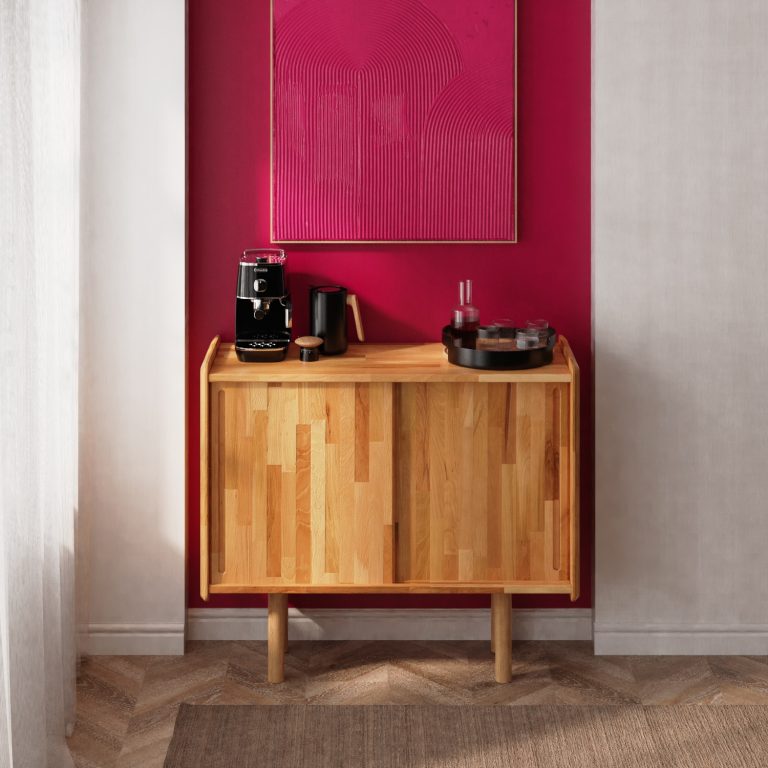
Japandi values the balanced use of contrast. As mentioned in the color palette, livelier nature-inspired hues such as greens or soft blues are used against the neutral, natural palette to create gentle contrasts. Contrast can also be built through different textures and patterns. Pairing a textured wall surface with a smooth, soft fabric, or combining a naturally textured rug with a plain floor, are further examples of how to achieve that balanced-contrast look.
[ux_image id=”4510″]
Minimal Decorative Elements
A small number of carefully chosen decorative pieces is one of the Japandi style’s most important touches. A few vases, candles, or a simple handmade textured painting fill the space in just the right way while preserving its calm.
Lighting also matters a great deal in the Japandi style. Beyond inviting natural light into the space, fixtures chosen with function and pared-back style as the priority make wonderful finishing touches. Lampshades in beige, cream, or light wood tones, and pendants or lamps made of simple, natural materials with clean lines, complete the Japandi aesthetic.
In short, Japandi can be described as being built on embracing minimalism and an uncomplicated, natural way of living. It is a profound approach to decoration — and in a sense a ‘way of life’ — that seeks to reunite people with nature, adopts staying true to the essence and letting go of unnecessary detail as its philosophy, and, when applied well, delivers a beautifully measured sense of warmth and welcome. Japanese culture, home to many philosophies centered on harmony with nature, inner calm, simplicity, and impermanence, inspires us all on profound questions such as the meaning and essence of life, while also charting a path for the spaces we live in along these same lines. Perhaps that is why it deserves rather more attention than many other decorating styles.
Canan Pervis