ON UNDERSTANDING MINIMALISM
Minimalism is a concept we use frequently these days, and one that keeps growing in popularity. We see its reflections in many fields, yet from time to time we can struggle to draw the boundaries of this approach. So what exactly is minimalism, and what is it not? In which areas do we see its effects, and how? Perhaps it is worth starting with a brief look at the definition of minimalism:
The word “minimalism” derives from “minimal”, which means “minimum” in French. While the dictionary defines the word minimum as “the least or smallest amount required for something”, its mathematical expression is “the lowest step to which a variable quantity can descend — the minimum, the minimal”.
While it was a concept that first appeared in the art world of the early twentieth century with the Modernism movement, it would not be wrong to say that today it has been embraced as a ‘philosophy of life’. The words we reach for when trying to define minimalism — ‘simplicity’, ‘plainness’ — actually carry more meaning than their dictionary entries. So how did a concept that first revealed itself in art with the Modernism movement expand into our lives and turn into a ‘lifestyle’? The answer, in fact, begins entirely with the change in our consumption habits.
Consumption is a phenomenon that has existed since the dawn of human history. People have always worked to secure the things they need in order to sustain their lives, just as we do today. But while earlier economies were agricultural and comparatively limited, the Industrial Revolution, as we all know, opened a genuinely new era. The shift to mass production made possible by technological progress changed the entire balance of supply and demand, pushing producers worldwide toward new market strategies and competition — in short, toward working to get people to consume ever more.
We all know this, of course. Yet to define minimalism as a way of life, we have to touch on consumption, because minimalism is, in every sense, about consuming ‘just enough’. Today we are surrounded on every side by countless products and countless services. Whether we like it or not, we are steered toward ‘consuming more’ in dozens of different ways every single day, and we go along with it out of habit — often without truly questioning it. Through various mechanisms, we are psychologically conditioned to believe there is always something better, and that we must have it. As a result of all this, ever shorter-lived, lower-quality objects are marketed to us in an endless ‘use and toss – buy a new one’ cycle.
This is precisely where minimalism steps in — a system of thought that questions the situation. It is not only about tangible objects; it is about living a ‘simpler’ life in every area of the everyday. Using everything we own more effectively, not wasting time and energy on what we do not realistically need, and, in a sense, becoming ‘free’. The famous architect Ludwig Mies van der Rohe, a pioneer of the minimalist movement, actually sums it up beautifully: “It is not poverty, deprivation, or lack. Minimalism is, on the contrary, a conscious choice; it is choosing the harder path, doing much with little. Less is more.”
Questioning whether we genuinely need something before buying it and using it to the end of its life, making good use of what we have, eating and drinking just enough — even, in a sense, keeping just enough relationships. It is rather like trying, within our own way of thinking, to step outside the wheel and find our true selves.
At this point we also need to consider ‘frugality’, a concept closely related to minimalism — for although the two are built on fundamentally similar principles, they are two concepts with different focal points.
[ux_image id=”4520″]
Frugality is a lifestyle focused chiefly on saving and cutting expenses. People who take this approach generally prefer to spend less money, and therefore avoid any unnecessary expense. Frugality is associated with practical strategies such as regular budgeting, following discounts, and shopping second-hand. Frugal people spend money only on the things they need and steer clear of unnecessary luxury consumption. Frugality is not limited to saving money, however; it also involves using resources more efficiently and preventing waste. At their core, it is fair to say that both focus on consuming less and spending less by changing consumption habits and lifestyles.
Yet when we read between the lines of all these definitions, an important difference in philosophy emerges. While frugality uses practical financial strategies to save money, minimalism takes more radical steps — shedding possessions and simplifying — in order to streamline one’s way of life. To put it more plainly, frugality is driven largely by material concerns and approaches, whereas minimalism, through the simplicity it seeks to create in every area of life, aims at greater freedom, happiness, and meaning. A person who tries to place the minimalist approach at the center of their life focuses more on experiences, and on the efficiency and personal value of everything they own, whether material or otherwise. The best meal, for example, will not always be the most ‘economical’ option, as you might guess. At first glance this may seem to contradict minimalism, but for a minimalist, trying an expensive meal can be a genuinely valuable experience — a discovery of flavor, or a taste of a different culture. Such a dining experience can reflect, in keeping with a minimalist lifestyle, a focus on values beyond the material and an appreciation of meaningful experiences. For a frugal person, the meaning such a meal carries would be very different. In essence, the biggest point on which the two concepts diverge is the difference in the meaning they assign to material values.
I once saw something in a documentary that struck me deeply (I unfortunately cannot remember its name): wanting to build a minimal lifestyle, a woman drastically culled her wardrobe, keeping only a handful of garments she could mix and match with one another. For an entire year she wore only these to work, and when she asked her colleagues at the end of the year, she discovered that not one of them had even noticed. It affected me greatly, because it made me question myself from the same perspective. Clothes, belongings, or anything else — it does not matter what. Objects exist only as much as the meanings we attach to them, and any value given beyond its due can, past a certain point, turn into a shackle around our ankles.
Drawing the boundaries of ‘less’ is difficult. Of course we are all different individuals, with different needs and wants and different living conditions. But the measure is, after all, ‘enough’ — and that can vary for each of us. What matters is to strip away the unnecessary details within our own circumstances, devote more energy to what is important to us, and find a balance that suits our own way of living. When we achieve all this, at the end of the day, a home cleared of excess belongings, less complicated and more genuine relationships, a clear way of communicating, and the ‘clean’ mind we will gain truly look like a door opening onto a more peaceful life.
One of the greatest benefits of consuming relatively less is generating less environmental waste. As we all know, the world’s population keeps growing and natural resources are being depleted at a terrifying pace. The harmful waste created by our use-and-toss mentality and released into nature ultimately harms us most of all. Yes, we all love nature — but how much of what we could do to protect it we actually do is debatable. Buying what is necessary and long-lasting, and thus producing less waste, is one of the biggest steps we can take here, and it truly requires a higher level of awareness.
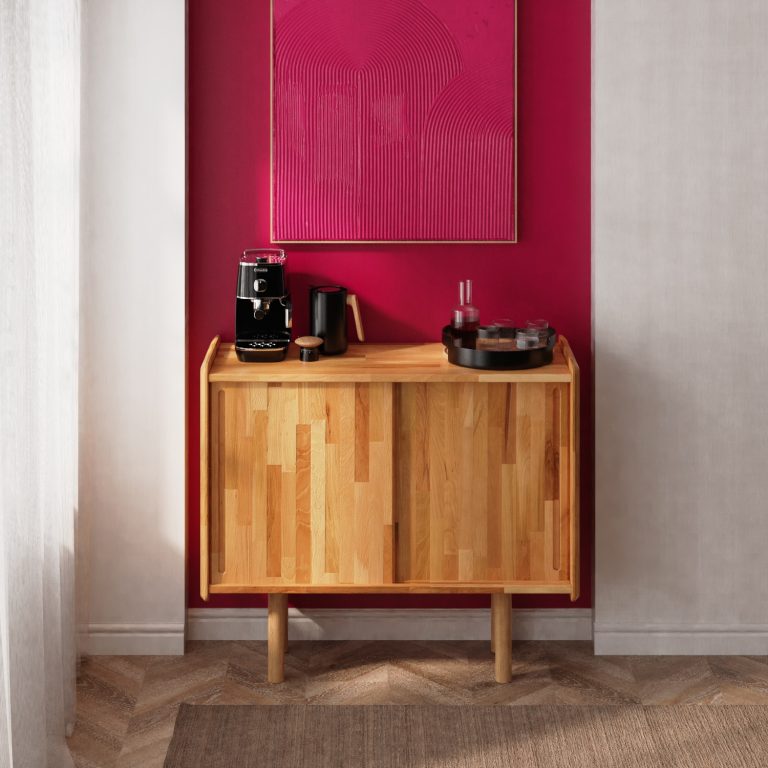
At Demontha, what has always underpinned our minimalist design line is acting with exactly this awareness, and offering users products they can buy with complete peace of mind in every sense. As a design philosophy, our priorities are functionality and an aesthetic far removed from ostentation.
That is why we use one hundred percent recyclable materials in all our furniture, and thanks to their flat-pack design, our products are easy to move and built to last. For every product you buy, we donate a sapling on your behalf, striving to give back what we take from nature. Yes — we are simply trying to do our best.
Canan PERVİS